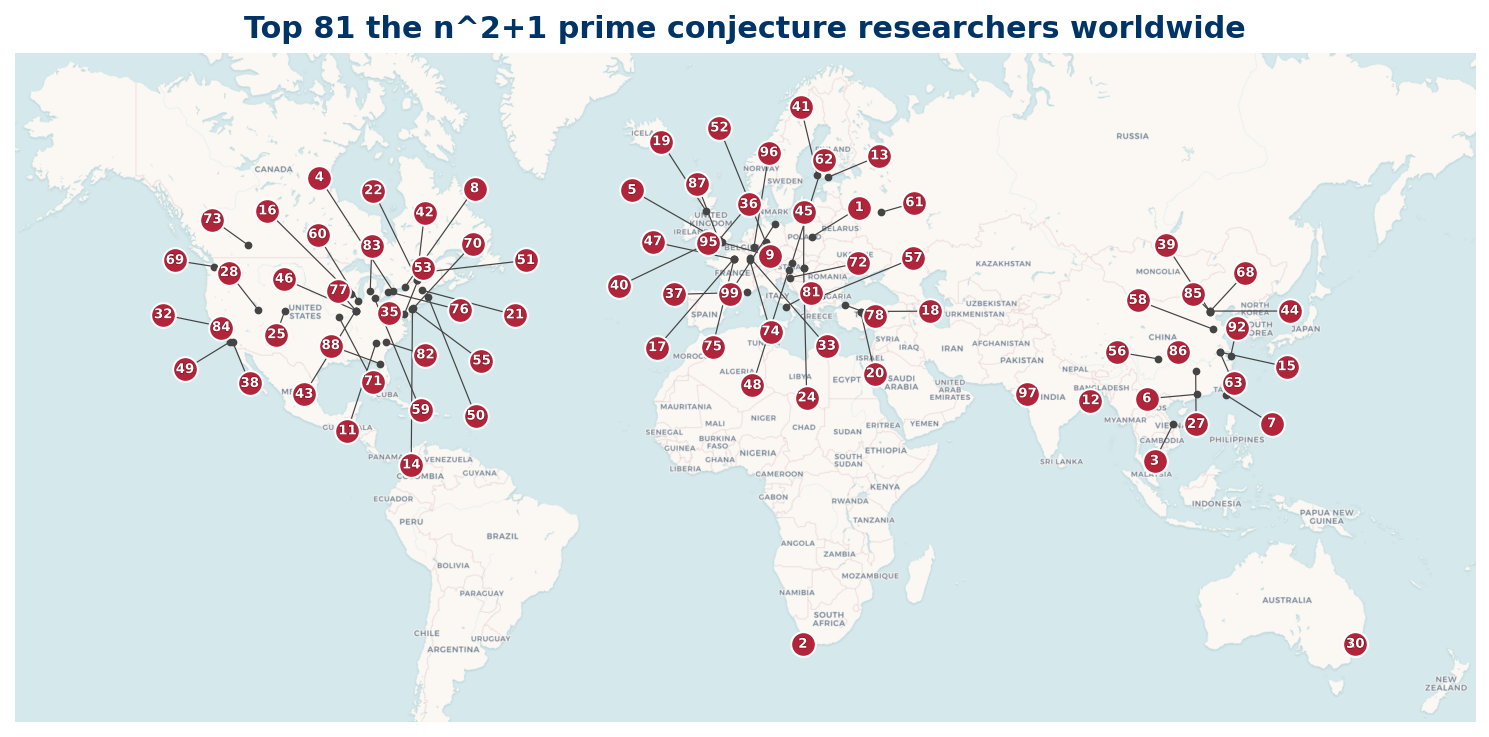
Who's Who in n^2+1 Primes Research
A directory of researchers working on the n^2+1 prime conjecture
The n2+1 conjecture asks whether the polynomial n2+1 produces infinitely many prime values: 2, 5, 17, 37, 101, 197, 257, and so on. This is one of Edmund Landau four classical problems, presented at the 1912 International Congress of Mathematicians in Cambridge, alongside Goldbach conjecture, the twin prime conjecture, and Legendre conjecture. The conjecture is still open.
The problem belongs to a broader family: given an irreducible polynomial with integer coefficients and no fixed prime divisor, does it represent infinitely many primes? The general form of this question is Bunyakovsky conjecture (1857), and the simultaneous version for several polynomials is Schinzel Hypothesis H. For n2+1 specifically, Hardy and Littlewood gave in 1923 a precise quantitative prediction for how many primes of this form fall below x, as part of their Conjecture F (a special case of the Bateman-Horn conjecture). The prediction matches computational data closely, yet no proof exists.
The closest results are by Henryk Iwaniec, who proved in 1978 that n2+1 is a product of at most two primes infinitely often (using the half-dimensional sieve), and by John Friedlander and Henryk Iwaniec, who proved in 1997 that the polynomial x2+y4 represents infinitely many primes: the first time a sparse two-variable polynomial was shown to be prime-producing. Roger Heath-Brown later extended the method to x3+2y3. Jori Merikoski (2023) proved that n2+1 has a prime factor exceeding n6/5 infinitely often, a result in the direction of the problem, though not a prime-values result directly.
This site is a reference directory of the researchers most active on the n2+1 conjecture and the surrounding community: polynomial prime values, the Bateman-Horn conjecture, the half-dimensional sieve, and the Friedlander-Iwaniec method. Rankings are built from arXiv preprint output, OpenAlex citation data, and zbMATH MSC classifications (11N32, 11N35, 11N36). Because the problem is specialized, the community is smaller than for Goldbach or twin primes. The corpus reflects that: a focused field.
How the list is built
Three independent signals are combined into one composite ranking:
- arXiv preprint output, filtered to math.NT and math.CO categories, matched against 12 search terms.
- OpenAlex topical citations.
- zbMATH Open, using the MSC subject classes (11N32, 11N35, 11N36).
The three pipeline ranks are combined with a weighted order statistic: for each researcher the three ranks are sorted and weighted 70% on the best, 20% on the middle, and 10% on the worst. Lower is better. See the methodology for details.
Top 100 at a glance
100 researchers, drawn from 20 countries.
| Country | Top 100 researchers |
|---|---|
| US | 25 |
| CN | 12 |
| CA | 7 |
| GB | 7 |
| FR | 6 |
| DE | 3 |
| TR | 3 |
| AT | 2 |
| AU | 2 |
| FI | 2 |
| HU | 2 |
| IN | 2 |
| BG | 1 |
| HR | 1 |
| IT | 1 |
| PL | 1 |
| RU | 1 |
| TW | 1 |
| VN | 1 |
| ZA | 1 |
| Unknown | 19 |
Where to start
- The Top 100 is the canonical ranked list, sortable in your browser.
- Regional listings: North America, Europe, Asia & Pacific, Other regions.
- Reading list: short papers from 2018 onward, with clickable links.
- Data: the ranked list as an open CC-BY dataset, with a citable DOI.
- Methodology: how the data is built, audit decisions, and limitations.
Citing this site
Hubbard, S. (2026). Who's Who in n^2+1 Primes Research. Zenodo. https://doi.org/10.5281/zenodo.20674899